

Service Connection 101: How to Tie Your Condition to Military Service
Service Connection Is the Make-or-Break Factor in Every VA Claim
You can have a serious diagnosis.
You can be struggling every day.
You can have served honorably.
And still be denied.
Why? Because service connection is the legal backbone of every VA disability claim. Without it, the VA cannot approve compensation—no matter how real or severe your condition is.
At Warrior Benefits, this is where most claims succeed or fail. Not because veterans don’t qualify—but because service connection is misunderstood, assumed, or poorly explained.
This article breaks service connection down in plain English so you know exactly what the VA is looking for—and how to give it to them.
What “Service Connection” Actually Means
Service connection simply means the VA agrees that:
Your current medical condition is linked to your military service.
That link doesn’t have to be obvious.
It doesn’t have to be immediate.
And it doesn’t have to be diagnosed while you were in uniform.
It just has to be legally and medically supported.
The Three Elements the VA Requires for Service Connection
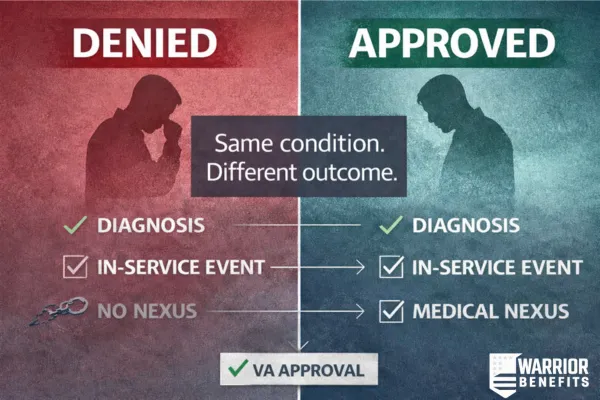
To establish service connection, the VA must see all three of the following:
1. A Current Diagnosis
You must have a medically recognized condition now.
2. An In-Service Event, Injury, Illness, or Exposure
Something must have happened during service that could reasonably cause or worsen the condition.
3. A Medical Nexus
A medical explanation connecting the two.
If even one of these elements is missing or unclear, the VA will likely deny the claim—even if everything else seems obvious.
1. The Current Diagnosis: More Than Just Symptoms
The VA does not compensate symptoms alone. It compensates diagnosed conditions.
A valid diagnosis must:
Identify a specific condition
Come from a qualified medical professional
Be current and clearly documented
Common Veteran Mistake
Many veterans assume treatment equals diagnosis. It doesn’t.
Notes like “back pain,” “anxiety,” or “sleep problems” are not diagnoses by themselves. If the condition isn’t clearly named, the VA may treat it as nonexistent.
2. The In-Service Event: What Happened During Service
This is where many veterans mistakenly disqualify themselves.
An in-service event can include:
A documented injury
Repetitive physical stress
Psychological trauma
Toxic or environmental exposure
MOS-related wear and tear
Deployment conditions
The VA does not require the condition to be diagnosed during service. Many conditions:
Develop years later
Were ignored due to mission demands
Were misunderstood at the time
What matters is whether something occurred that could reasonably lead to the condition you have now.
Evidence That Can Prove an In-Service Event
The VA accepts many forms of evidence, including:
Service treatment records
Personnel and deployment records
Unit or MOS documentation
Lay statements from you or others
Consistent post-service medical history
Perfect records are not required. Credible and consistent evidence is.
3. The Nexus: Where Most Claims Break Down
The nexus is the medical bridge between your service and your diagnosis.
In VA terms, the question is:
Is it “at least as likely as not” that the condition is related to service?
This doesn’t mean absolute certainty. It means reasonable medical probability.
Why Veterans Struggle With the Nexus
They assume the connection is obvious
They expect the VA to connect the dots
They submit records without explanations
The VA does not infer relationships. If the connection isn’t clearly stated, it often doesn’t exist in the decision-maker’s eyes.
The Three Main Types of Service Connection
Veterans generally qualify under one (or more) of these categories:
1. Direct Service Connection
The condition began during service or can be directly tied to a specific event or exposure.
2. Secondary Service Connection
The condition exists because of another service-connected disability (covered in depth in our secondary conditions guide).
3. Aggravated Service Connection
A condition existed before service but was permanently worsened beyond normal progression due to service.
Each type has different evidence needs—but all are valid.
What Service Connection Does Not Require
Despite popular belief, service connection does not require:
❌ A diagnosis during service
❌ Perfect medical records
❌ Combat service (for most conditions)
❌ A single traumatic event
❌ A dramatic story
Service connection is about probability and consistency, not perfection.
Why Service Connection Claims Get Denied
Most service-connection denials happen because:
One of the three elements was missing
The nexus wasn’t clearly explained
Evidence existed but wasn’t tied together
Veterans assumed the VA would “figure it out”
A denial doesn’t always mean you don’t qualify. It often means the VA didn’t get what it legally needs to say yes.
Why Timing and Strategy Matter
The earlier service connection is established:
The easier evidence is to gather
The clearer medical history is
The more back pay can be protected
This is why filing an Intent to File early—before everything is perfect—is often the smartest move.
How Service Connection Fits Into a Smart VA Strategy
At Warrior Benefits, service connection is never treated as an afterthought. It’s the foundation.
Strong claims:
Clearly identify the service event
Use focused evidence
Explain medical relationships plainly
Avoid unnecessary paperwork
Protect effective dates early
This approach reduces denials, delays, and frustration.
Final Thoughts: Service Connection Is a Skill—Not a Guess
Service connection isn’t about luck. It’s about understanding how the VA evaluates claims and presenting your case clearly.
Many veterans qualify for benefits they never receive—not because they’re undeserving, but because no one explained how service connection really works.
Once you understand it, everything else becomes easier.
Get the Connection Right From the Start
Don’t let a missing link cost you your benefits.
Contact Warrior Benefits to review your condition, identify the strongest service-connection path, and build your claim on a solid foundation.
Strong claims start with clear connections.