


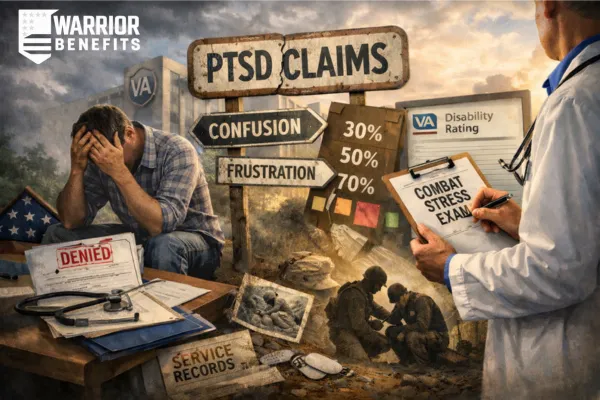
PTSD Claims: What Veterans Need to Know Before Filing
PTSD Claims Are Common — and Commonly Mishandled
Post-Traumatic Stress Disorder (PTSD) is one of the most frequently filed VA disability claims. It’s also one of the most misunderstood.
Many veterans assume that if they are honest about what they’ve experienced, the VA will “do the right thing.” Unfortunately, PTSD claims don’t fail because veterans lie — they fail because veterans don’t understand how the VA evaluates them.
At Warrior Benefits, PTSD claims are one of the areas where we see the most frustration, confusion, and unnecessary denials. Veterans are often qualified — but unprepared.
This article is not about gaming the system. It’s about understanding it, so your experience is evaluated accurately.
How the VA Actually Evaluates PTSD Claims
For the VA to approve a PTSD claim, four elements must be present:
A current PTSD diagnosis
A qualifying in-service stressor
A medical link (nexus) between the stressor and the diagnosis
Evidence of functional impairment
Missing or poorly documented elements lead to denials or low ratings.
1. The PTSD Diagnosis: Why “Symptoms” Aren’t Enough
The VA does not rate PTSD based on symptoms alone. You must have:
A formal PTSD diagnosis
From a qualified mental health professional
Documented clearly in medical records
A provider noting “anxiety,” “sleep issues,” or “stress” does not automatically equal PTSD. Many veterans assume they’ve been diagnosed when they haven’t.
If the diagnosis isn’t explicit, the VA may deny the claim outright.
2. Stressors Don’t Have to Be Combat-Related
One of the biggest myths surrounding PTSD claims is that they require direct combat.
That is false.
Qualifying stressors can include:
Combat exposure
Military sexual trauma (MST)
Training accidents
Witnessing injury or death
Fear-based deployments
Repeated exposure to trauma
Non-combat hostile environments
Many veterans disqualify themselves before filing because they believe their stressor “doesn’t count.” The VA’s definition is far broader than most realize.
3. Stressor Verification: What the VA Needs
The VA must be able to verify the stressor unless it falls under special categories (such as fear-based stressors or MST).
Verification may come from:
Service records
Deployment history
Unit records
Credible lay statements
Behavioral markers (especially for MST)
Perfect documentation is not required — but credible consistency is.
4. Functional Impairment Is What Drives Ratings
This is where many PTSD claims fall short.
The VA does not rate PTSD based on:
How traumatic the event was
How long ago it happened
How much it “should” affect you
The VA rates PTSD based on:
Occupational impairment
Social impairment
Symptom frequency
Symptom severity
Functional limitations
Two veterans with the same diagnosis can receive very different ratings depending on how impairment is documented.
Why PTSD Claims Are Commonly Denied
PTSD claims are often denied because:
The diagnosis isn’t clearly documented
The stressor isn’t explained well
Symptoms are minimized during exams
Records and statements are inconsistent
Veterans focus on the event, not the impact
Denial does not mean the veteran doesn’t have PTSD. It usually means the VA didn’t get what it needed.
The C&P Exam: Where PTSD Claims Are Won or Lost
The Compensation & Pension (C&P) exam plays an outsized role in PTSD claims.
Many veterans walk into these exams:
Underprepared
Guarded
Minimizing symptoms
Focused on “being okay”
This often results in ratings that don’t reflect reality.
Common C&P Exam Mistakes Veterans Make
Veterans often:
Say “I’m fine” out of habit
Describe good days instead of bad ones
Avoid discussing work or relationship problems
Downplay anger, isolation, or sleep issues
Assume the examiner knows their history
The examiner only knows what you communicate — and what’s in the record.
Honesty Is Necessary — Completeness Is Critical
Being honest does not mean being vague.
Veterans should be prepared to explain:
How symptoms affect work
How they affect relationships
How often symptoms occur
How severe symptoms are on bad days
How symptoms have progressed over time
This is not exaggeration. It’s context.
PTSD Ratings Are About Function, Not Labels
The VA uses a general rating formula for mental health. Ratings are based on:
0%
10%
30%
50%
70%
100%
Each level corresponds to functional impairment, not trauma severity.
Veterans are often underrated because impairment wasn’t clearly described — not because the VA dismissed their experience.
PTSD Claims Filed Years After Service
There is no time limit on filing a PTSD claim.
Many veterans:
Avoid treatment for years
Self-manage symptoms
Normalize dysfunction
Seek help only after life disruption
Delayed filing does not invalidate a claim. However, evidence strategy becomes more important.
Why Preparation Changes Outcomes
Prepared veterans:
Understand what the VA is evaluating
Avoid minimizing symptoms
Stay consistent across records
Provide clearer evidence
Receive more accurate ratings
Unprepared veterans often leave their fate to a 30-minute exam.
PTSD Claims Are Not About Weakness
Seeking compensation for PTSD is not weakness.
It is recognition that service has lasting consequences.
The VA system exists because trauma does not end at discharge.
How PTSD Fits Into a Smart VA Strategy
At Warrior Benefits, PTSD claims are handled with:
Education
Structure
Sensitivity
Strategy
The goal is not to dramatize trauma — it’s to ensure the VA understands the full impact.
Final Thoughts: PTSD Claims Require Understanding, Not Guesswork
Many veterans live with PTSD for years without accurate recognition from the VA — not because they don’t qualify, but because they weren’t shown how the system works.
Once you understand how PTSD is evaluated, the process becomes less intimidating — and far more effective.
Don’t Navigate PTSD Claims Alone
Your experience deserves to be understood — not minimized.
Contact Warrior Benefits to learn how PTSD claims are evaluated, prepare for exams, and pursue benefits with clarity and respect.
Strong claims start with understanding.