


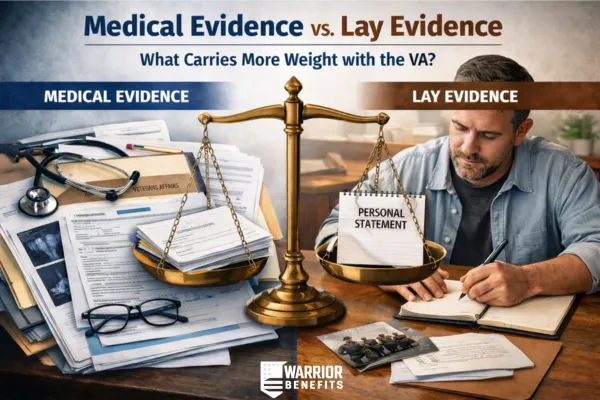
Medical Evidence vs. Lay Evidence: What Carries More Weight With the VA?
Evidence Is the Backbone of Every VA Claim — But Not All Evidence Works the Same
One of the most common questions veterans ask during the VA claims process is:
“What matters more—medical records or my own statement?”
The honest answer is: neither wins on its own.
Most VA claims are denied or underrated not because veterans lack evidence, but because they misunderstand how the VA evaluates different types of evidence and how those pieces are supposed to work together.
At Warrior Benefits, we see this mistake constantly. Veterans submit stacks of medical records with no explanation—or heartfelt statements with no medical backing—and assume the VA will put it all together.
It won’t.
This article breaks down the difference between medical evidence and lay evidence, what each one is responsible for proving, and how to combine them into a claim the VA can actually approve.
The VA Doesn’t Look for “More Evidence” — It Looks for the Right Evidence
The VA is not grading effort. It is evaluating whether specific legal requirements are met.
When reviewing evidence, the VA is asking:
Is the condition diagnosed?
Is it connected to service?
How severe is it?
How does it affect daily function?
Different types of evidence answer different parts of that question. Understanding that distinction changes everything.
What Is Medical Evidence?
Medical evidence is documentation created by qualified healthcare professionals. It establishes the clinical side of your claim.
Examples include:
Diagnoses
Treatment records
Progress notes
Test results
Medical opinions
C&P exam reports
Medical evidence answers the question:
“What is the condition, and what is happening medically?”
What Medical Evidence Is Best At Proving
Medical evidence is critical for:
Establishing a current diagnosis
Demonstrating severity under VA rating criteria
Supporting a medical nexus
Explaining complex conditions or causation
Without medical evidence, most claims cannot legally be approved.
Where Medical Evidence Often Falls Short
Medical records are written for treatment—not for VA claims.
That means they often:
Use clinical shorthand
Focus on symptoms, not function
Miss day-to-day impact
Understate severity
Lack explanation of service connection
A doctor may write “chronic back pain,” but never document:
How often it flares
How it limits work
How it affects sleep or mobility
That’s where lay evidence becomes critical.
What Is Lay Evidence?
Lay evidence is testimony from non-medical individuals describing what they personally observe.
This includes:
Veteran personal statements
Statements from spouses or family members
Coworker or supervisor statements
Buddy statements from service members
Lay evidence answers the question:
“How does this condition actually affect daily life?”
What Lay Evidence Is Best At Proving
Lay evidence is powerful for explaining:
Symptom frequency
Functional limitations
Behavioral changes
Work impact
Flare-ups
Progression over time
The VA is legally required to consider credible lay evidence—even if it isn’t supported by medical documentation for every detail.
Common Misconception: “My Statement Doesn’t Matter”
Many veterans believe:
“The VA only cares about doctors”
“My word doesn’t count”
“If it’s not in my records, it doesn’t matter”
That’s incorrect.
Lay evidence is often the only place the VA sees the full picture—especially for mental health, pain conditions, migraines, and fluctuating symptoms.
What Lay Evidence Cannot Do
Lay evidence has limits. It cannot:
Replace a medical diagnosis
Establish complex medical causation
Override contradictory medical evidence
A veteran can say what they experience—but not diagnose why it exists medically.
That’s why balance matters.
How the VA Weighs Medical vs. Lay Evidence
The VA doesn’t choose one over the other. It looks at how well they align.
Strong claims show:
Medical records that establish diagnosis and severity
Lay statements that explain real-world impact
Consistency between the two
Weak claims show:
Medical evidence with no context
Emotional statements without medical support
Contradictions between records and testimony
Consistency builds credibility.
Where Most Veterans Go Wrong
Veterans typically fall into one of three traps:
1. Medical Records Only
Veterans submit hundreds of pages of records but never explain how the condition affects daily life.
Result: Underrated claims.
2. Lay Evidence Only
Veterans submit strong statements but lack diagnoses or nexus support.
Result: Denials.
3. Inconsistent Evidence
Symptoms described in statements don’t match medical records.
Result: Credibility issues.
How to Combine Medical and Lay Evidence the Right Way
The strongest VA claims:
Use medical evidence to establish what the condition is
Use lay evidence to explain what living with it looks like
Address VA rating criteria directly
Stay consistent across all documents
Think of medical evidence as the skeleton and lay evidence as the muscle and movement.
Special Importance for Mental Health Claims
Mental health claims rely heavily on lay evidence because:
Symptoms are internal
Severity fluctuates
Daily impact isn’t always visible in exams
Veteran and family statements often make the difference between:
A low rating
And an accurate one
Lay Evidence Is Also Critical for Older Claims
For veterans filing years after service:
Records may be incomplete
Providers may be unavailable
Documentation may be thin
Lay evidence can fill gaps when used correctly and consistently.
Quality Matters More Than Quantity
One clear, well-written statement is more powerful than:
Ten vague ones
Hundreds of pages of unrelated records
The VA values relevance and clarity—not volume.
How This Fits Into a Smart Claim Strategy
At Warrior Benefits, evidence strategy focuses on:
Filling gaps—not duplicating records
Explaining relationships clearly
Matching evidence to VA requirements
Avoiding contradictions
Strengthening credibility
This approach reduces denials and improves ratings.
Final Thoughts: Evidence Works Best When It Tells One Clear Story
Medical evidence and lay evidence are not competitors. They’re partners.
When used together, they:
Strengthen service connection
Support accurate ratings
Reduce appeals
Speed up decisions
Veterans don’t lose claims because they lack evidence. They lose claims because the evidence doesn’t tell a clear, unified story.
Build a Stronger Evidence Strategy
Don’t rely on one type of evidence alone.
Contact Warrior Benefits to review your medical records, craft effective lay statements, and build a claim strategy the VA can actually approve.
Strong claims aren’t louder—they’re clearer.